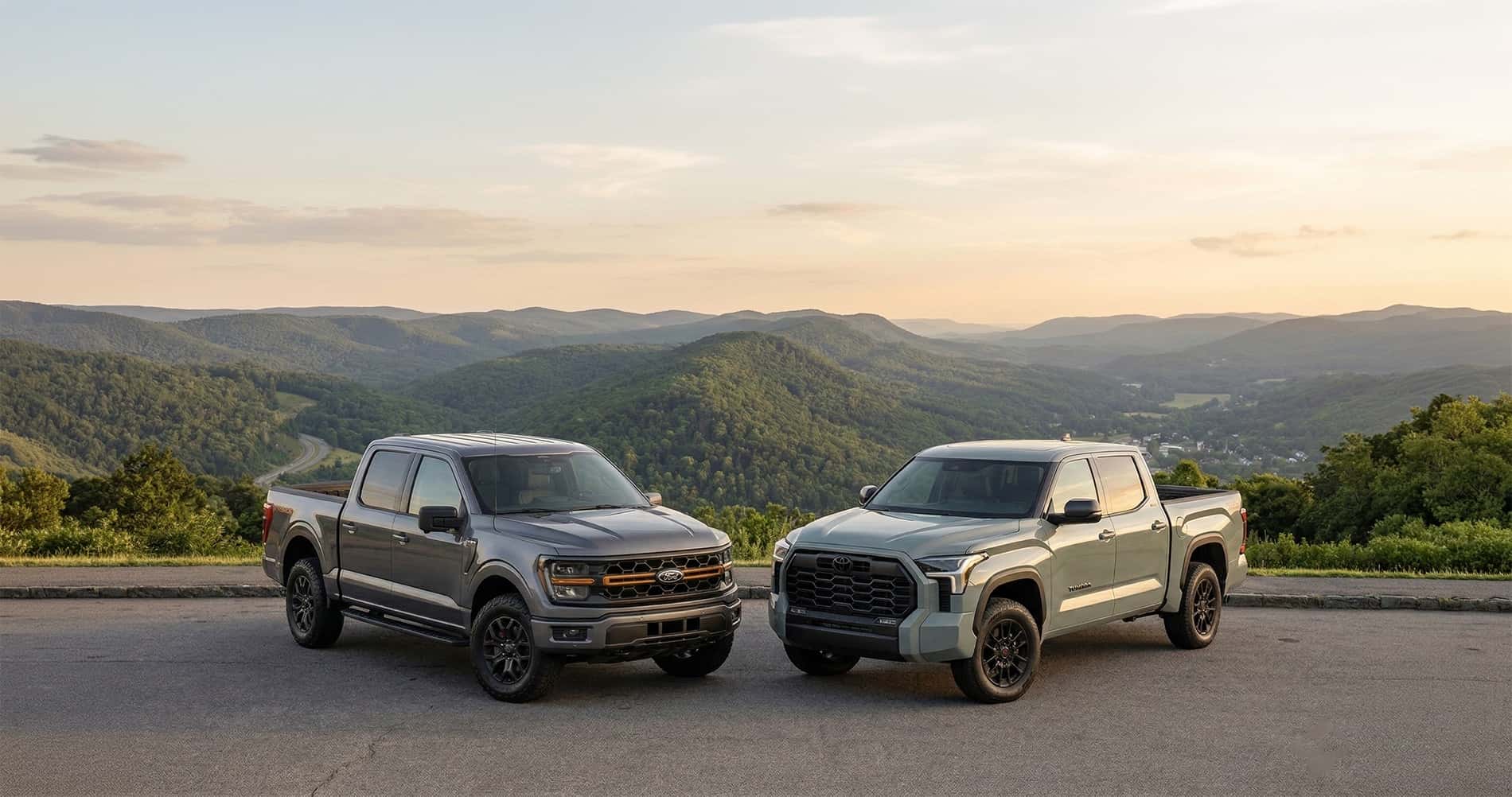
Full-size pickup buyers often find themselves comparing two of the most recognizable trucks on the road: the 2026 Ford F-150 and the Toyota Tundra. Both models bring serious capability, modern technology, and strong reputations for durability, which is why the F-150 vs Tundra comparison remains one of the most common decisions for truck shoppers. Whether you plan to tow equipment, haul gear, commute daily, or head out for weekend adventures, understanding how these trucks differ can make the buying process much clearer.
In this 2026 Ford F-150 vs Toyota Tundra guide, we’ll take a detailed look at the numbers and features that matter most to drivers. You’ll see how the trucks compare across pricing, engine options, towing and payload capability, exterior size, bed dimensions, interior space, technology features, and safety systems. By examining the Toyota Tundra vs Ford F-150 specs side by side, it becomes easier to understand where each truck shines and which one might better match your needs.
Throughout the comparison, you’ll notice that both trucks offer impressive performance and modern convenience features. The Ford F-150 stands out with its wide range of engines, strong towing capability, and flexible trim lineup, while the Toyota Tundra brings a powerful twin-turbo engine lineup, upscale interior options, and strong hybrid performance. Looking at the data together helps reveal how these differences translate into real-world capability for drivers around White Hall and Fairmont.
| Pricing Comparison | ||
|---|---|---|
| Trim Level | 2026 Ford F-150 MSRP* | 2026 Toyota Tundra MSRP* |
| Base Model | F-150 XL — $39,330 | Tundra SR — $41,260 |
| Entry Mid-Trim | F-150 STX — $41,855 | Tundra SR5 — $46,510 |
| Mid-Level Trim | F-150 XLT — $44,695 | Tundra Limited — $54,860 |
| Luxury Trim | F-150 Lariat — $59,560 | Tundra Platinum — $63,695 |
| Off-Road Performance | F-150 Tremor — $64,915 | Tundra TRD Pro — $72,565 |
| Western Luxury Trim | F-150 King Ranch — $65,825 | Tundra 1794 Edition — $64,380 |
| Premium Luxury Trim | F-150 Platinum — $68,800 | Tundra Capstone — $80,800 |
| High-Performance Trim | F-150 Raptor — $79,005 | — |
When looking at the numbers in this pricing comparison, one of the biggest takeaways in the F 150 vs Tundra conversation is how each truck approaches value across the trim lineup. At the entry point, the 2026 Ford F-150 XL starts at $39,330, giving it a slight advantage over the Toyota Tundra SR at $41,260. That trend continues through several trims, with models like the F-150 STX and XLT positioned at lower starting prices than the comparable Tundra SR5 and Limited. For many buyers, that difference can translate into meaningful savings or the opportunity to step into a higher trim level for a similar budget.
As you move into the upper trims, the gap narrows. The F-150 Lariat and Tundra Platinum are relatively close in price, while the Tundra 1794 Edition actually undercuts the F-150 King Ranch slightly. At the very top of the range, however, the Tundra Capstone climbs to a noticeably higher price point than the F-150 Platinum, showing how Toyota’s luxury-focused trim pushes the ceiling of the lineup.
Looking at the Ford F 150 vs Toyota Tundra specs from a pricing perspective, the Ford lineup also offers more variety, including specialized trims like the off-road-focused Tremor and the high-performance Raptor. That broader spread gives drivers around Fairmont, Clarksburg, and Morgantown more flexibility to match capability, comfort, and price with how they actually use their truck. At the same time, Toyota deserves credit for offering upscale interior finishes and strong premium options in trims like the Platinum and Capstone, which appeal to buyers who prioritize luxury in a full-size pickup.
| F-150 vs Tundra: Powertrain, Towing & Payload Highlights | ||
|---|---|---|
| Comparison Point | Ford F-150 | Toyota Tundra |
| Engine Lineup (Overview) | 2.7L EcoBoost® V6 • 3.5L EcoBoost® V6 • 5.0L Ti-VCT V8 3.5L PowerBoost® Hybrid V6 • High-Output 3.5L EcoBoost® V6 (Raptor) • 5.2L Supercharged V8 (Raptor R) |
i-FORCE 3.4L Twin-Turbo V6 • i-FORCE MAX 3.4L Twin-Turbo Hybrid V6 |
| Horsepower Range | 325–720 hp | 358–437 hp |
| Torque Range | 400–640 lb-ft | 406–583 lb-ft |
| Transmission | 10-Speed Automatic | 10-Speed Automatic |
| Drivetrain Availability | RWD Or 4WD (Varies By Engine/Trim) | RWD Or 4WD (i-FORCE); 4WD (i-FORCE MAX) |
| Best For Maximum Towing | 3.5L EcoBoost® V6 — 13,500 Lbs | i-FORCE 3.4L Twin-Turbo V6 — Up To 12,000 Lbs |
| Maximum Towing Range | 8,400–13,500 Lbs | Up To 11,450–12,000 Lbs |
| Best For Maximum Payload | 3.5L EcoBoost® V6 — 2,440 Lbs | i-FORCE 3.4L Twin-Turbo V6 — Up To 1,940 Lbs |
| Maximum Payload Range | 1,740–2,440 Lbs | Up To 1,680–1,940 Lbs |
| Hybrid Option Summary | 3.5L PowerBoost® Full-Hybrid V6 — 430 hp / 570 lb-ft | i-FORCE MAX Hybrid V6 — 437 hp / 583 lb-ft; Electric Motor Torque: 184 lb-ft |
| Best Fuel Economy (Available Hybrid) | 3.5L PowerBoost® Full-Hybrid V6 — 25 / 26 MPG | i-FORCE MAX 3.4L Hybrid V6 — Up To 20 / 24 MPG |
When comparing capability, the numbers in this table help clarify why the Ford F-150 continues to stand out in the full-size truck segment. In the broader f 150 vs tundra conversation, one of the most noticeable differences is the sheer variety of engines available in the F-150 lineup. Ford offers multiple gas engines, a hybrid option, and even high-performance variants like the Raptor and Raptor R. By contrast, the Toyota Tundra focuses on a smaller range built around its twin-turbo V6 and hybrid powertrain. While Toyota’s approach emphasizes modern turbocharged efficiency, Ford’s wider engine lineup gives drivers more flexibility depending on whether they prioritize work capability, performance, or fuel efficiency.
Towing and payload are two areas where the Ford F-150 vs Toyota Tundra specs become especially important for everyday use. The F-150 can tow up to 13,500 pounds when properly equipped, which is higher than the Tundra’s maximum rating of around 12,000 pounds. Payload capacity shows a similar pattern, with the F-150 reaching up to 2,440 pounds compared to roughly 1,940 pounds for the Tundra. For drivers hauling trailers, work equipment, or recreational gear around places like Bridgeport, Grafton, or Buckhannon, that difference can make a practical impact.
Toyota deserves credit for its strong hybrid system, which produces impressive torque and competitive horsepower. However, the F-150 hybrid balances performance with higher fuel economy ratings and fits into a broader range of powertrain choices, making it easier for many buyers to find the right setup for their needs.
| Exterior Dimension | Ford F-150 SuperCrew 5.5′ Bed | Toyota Tundra CrewMax 5.5′ Bed |
|---|---|---|
| Wheelbase | 145.4″ | 145.7″ |
| Overall Length | 232.0″ | 233.6″ |
| Cab Height | 75.4″ – 77.1″ | 78.0″ |
| Width (Excluding Mirrors) | 79.9″ | 80.2″ |
| Track Width (Front) | 67.9″ | 68.4″ |
| Track Width (Rear) | 68.3″ | 68.4″ |
When comparing full-size trucks, exterior dimensions may seem like small details, but they can influence how the vehicle feels on the road and in everyday situations. Looking at the numbers in this table helps clarify some of the subtle differences in the ford f 150 vs toyota tundra specs. Overall, the two trucks are very similar in size. The Toyota Tundra CrewMax is slightly longer and a bit wider, while the Ford F-150 SuperCrew comes in just a touch lower in overall height depending on configuration.
These differences are small enough that most drivers will experience both trucks as large, capable pickups, but they can still affect day-to-day usability. For example, the slightly shorter overall length of the F-150 can make it a little easier to maneuver in tight parking lots or garages. That can be helpful for drivers navigating busy areas around Fairmont or Morgantown where parking space can be limited.
Wheelbase measurements between the two trucks are also very close, which means both models deliver similar stability when towing or carrying heavy loads. This is important in the broader f 150 vs tundra comparison because wheelbase length helps influence ride comfort and control when hauling a trailer. The near-identical track widths also show that both trucks are engineered to provide a wide, stable stance on the road.
In practical terms, buyers comparing these two pickups will find that exterior size is more about subtle driving feel than major capability differences.
| Bed Dimension | Ford F-150 5.5′ Bed | Ford F-150 6.5′ Bed | Toyota Tundra 5.5′ Bed | Toyota Tundra 6.5′ Bed |
|---|---|---|---|---|
| Bed Length | 67.1″ | 78.9″ | 65.6″ | 77.6″ |
| Bed Width (Between Wheelhouses) | 51″ | 51″ | 48.7″ | 48.7″ |
| Bed Width (Max) | 65″ | 65″ | 58.7″ | 58.7″ |
| Bed Depth / Side Height | 21″ | 21″ | 20.9″ | 20.9″ |
Bed size is one of the most practical factors truck buyers consider, especially for drivers who regularly haul tools, building materials, or outdoor gear. Looking at the numbers in this table helps highlight an important difference in the Ford F-150 vs Toyota Tundra comparison. While both trucks offer similar 5.5-foot and 6.5-foot bed configurations, the Ford F-150 provides slightly longer and noticeably wider cargo space.
For example, the 5.5-foot bed in the F-150 measures 67.1 inches long compared to 65.6 inches in the Toyota Tundra. The longer 6.5-foot bed also gives the Ford a small advantage. These differences may seem minor at first glance, but when loading longer items like ladders, lumber, or camping gear, even a few extra inches can make the process easier.
The biggest practical difference appears in bed width. The F-150 offers 51 inches of space between the wheelhouses, which allows standard four-foot sheets of plywood or drywall to sit flat in the bed. The Tundra measures about 48.7 inches in that same area, which means larger materials may need to be placed at an angle. Maximum bed width also favors Ford at 65 inches compared with about 58.7 inches in the Tundra.
When reviewing Toyota Tundra vs Ford F-150 specs from a cargo perspective, these differences translate into everyday usability. For truck owners in areas like Bridgeport, Fairmont, or Buckhannon, the extra width and slightly longer bed can make hauling work materials or weekend gear simpler and more efficient.
| Interior Dimension | Ford F-150 SuperCrew | Toyota Tundra CrewMax |
|---|---|---|
| Seating Capacity | 6 | 5 |
| Headroom (Front) | 40.8″ | 41.0″ |
| Headroom (Rear) | 40.4″ | 38.5″ |
| Legroom (Front) | 43.9″ | 41.2″ |
| Legroom (Rear) | 43.6″ | 41.6″ |
| Shoulder Room (Front) | 66.7″ | 65.0″ |
| Shoulder Room (Rear) | 66.0″ | 62.4″ |
| Hip Room (Front) | 62.5″ | 62.6″ |
| Hip Room (Rear) | 62.6″ | 60.5″ |
Interior space plays a big role in everyday comfort, especially for drivers who use their truck as both a work vehicle and a family hauler. Looking at the numbers in this table helps highlight an important difference in the Ford F-150 vs Toyota Tundra comparison. While both trucks offer spacious cabins, the Ford F-150 SuperCrew generally provides more room for passengers, particularly in the back seat.
One of the first things many buyers notice is seating capacity. The F-150 can accommodate up to six passengers when equipped with a front bench seat, while the Toyota Tundra CrewMax is designed for five. That extra seating position can be helpful for families or work crews who occasionally need room for one more passenger.
Rear passenger comfort is another area where the F-150 stands out. With 43.6 inches of rear legroom compared with 41.6 inches in the Tundra, back-seat passengers have noticeably more space to stretch out. Shoulder room and hip room measurements also favor the F-150, giving the rear cabin a slightly wider feel when multiple passengers are riding together.
The Toyota Tundra does deserve credit for offering slightly more front headroom, which can be appreciated by taller drivers. However, when looking at Toyota Tundra vs Ford F-150 specs overall, the Ford interior dimensions provide a bit more space where passengers tend to notice it most. For drivers traveling around White Hall, Clarksburg, or Morgantown, that extra rear-seat room can make longer drives more comfortable for everyone on board.
| Interior & Technology Feature | Ford F-150 | Toyota Tundra |
|---|---|---|
| Main Touchscreen Size | 12″ Capacitive Touchscreen with SYNC® 4 | 8″ Standard · 14″ Available Toyota Audio Multimedia |
| Digital Instrument Cluster | Available 12″ Digital Productivity Screen | Available 12.3″ Digital Gauge Cluster |
| Head-Up Display | Available Head-Up Display | Available 10″ Head-Up Display |
| Audio System | Available B&O® Unleashed Sound System by Bang & Olufsen® (18 Speakers) | Available JBL® 12-Speaker Premium Audio |
| Wireless Charging | Available Wireless Charging Pad | Available Qi Wireless Charging |
| Smartphone Integration | Wireless Apple CarPlay® & Android Auto™ | Wireless Apple CarPlay® & Android Auto™ |
| Front Seat Features | Available Heated & Ventilated Front Seats | Available Heated & Ventilated Front Seats · Available Massage Seats |
| Rear Seat Features | Available Heated Rear Seats | Rear Seat Air Vents · Available Heated Rear Seats |
| Interior Storage | Available Console Work Surface · Lockable Fold-Flat Storage | Rear Under-Seat Storage with Adjustable Partitions |
| Camera System | Available 360° Camera | Available Panoramic View Monitor |
| Drive Modes | Selectable Drive Modes | Drive Mode Select |
| Connectivity | FordPass™ Connect 5G LTE Wi-Fi Hotspot · Connected Navigation | Safety Connect · Service Connect · Remote Connect · Drive Connect · Wi-Fi Connect |
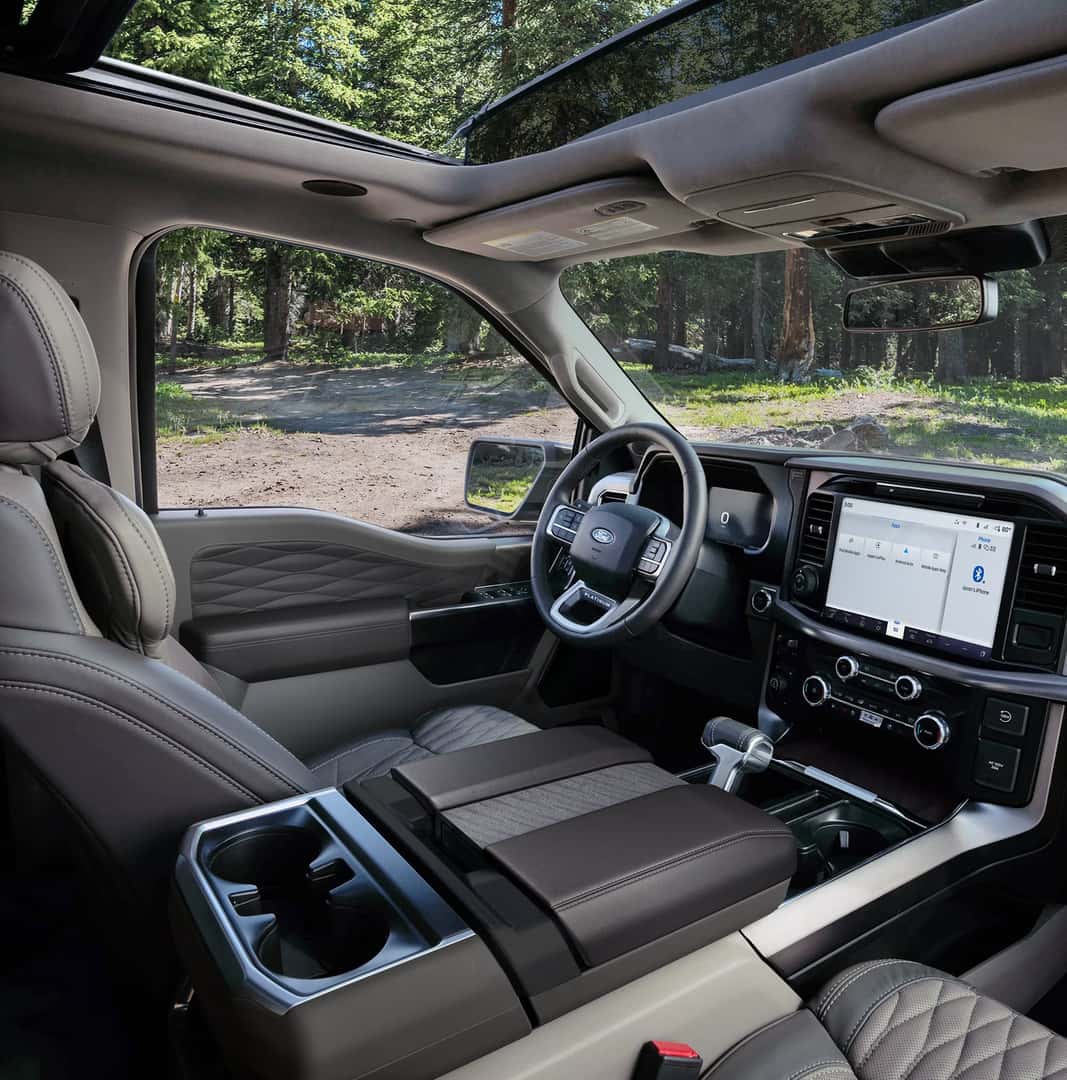
Technology and interior convenience features play a major role in how modern trucks feel during daily driving. Looking at the information in this table helps clarify how the Ford F-150 vs Toyota Tundra comparison plays out inside the cabin. Both trucks offer a strong mix of connectivity, entertainment, and comfort features, but they approach technology slightly differently.
The Ford F-150 centers its system around a 12-inch touchscreen running SYNC 4, which provides a large interface across much of the lineup. Toyota offers an 8-inch screen as standard in the Tundra, with a larger 14-inch display available on higher trims. That means buyers can access a bigger screen in the Tundra if they choose a higher trim, while the F-150 provides a large display right from the start.
Both trucks support wireless Apple CarPlay and Android Auto, making it easy for drivers to integrate their smartphones for navigation, music, and communication. Premium audio options are also available in each model, with Ford offering an 18-speaker Bang & Olufsen system and Toyota providing a JBL premium setup.
When reviewing Toyota Tundra vs Ford F-150 specs, interior practicality is another area worth noting. Features like the F-150’s available console work surface and fold-flat storage are designed with jobsite use in mind, while the Tundra offers thoughtful touches like under-seat storage and available panoramic camera technology. For drivers around Fairmont, Bridgeport, or Clarksburg, both trucks deliver modern technology, but the F-150 leans slightly toward work-focused versatility while still offering upscale comfort options.
| Safety / Driver Aid | Ford F-150 | Toyota Tundra |
|---|---|---|
| Forward Collision Warning | Pre-Collision Assist with Automatic Emergency Braking | Pre-Collision System with Pedestrian Detection |
| Automatic Emergency Braking | Automatic Emergency Braking | Automatic Emergency Braking with Pedestrian Detection |
| Adaptive Cruise Control | Available Adaptive Cruise Control with Stop-and-Go | Full-Speed Range Dynamic Radar Cruise Control |
| Lane Keeping / Lane Centering | Lane-Keeping System | Lane Departure Alert with Steering Assist |
| Hands-Free Driving | Available Ford BlueCruise Hands-Free Highway Driving | None |
| Parking Assistance | Available Active Park Assist | Front & Rear Parking Assist with Automatic Braking |
| Blind-Spot Monitoring | BLIS® with Cross-Traffic Alert and Trailer Tow Coverage | Blind Spot Monitor with Rear Cross-Traffic Alert and Trailer Merge Warning |
| Rear Cross-Path Detection | Cross-Traffic Alert | Rear Cross-Traffic Alert |
| Surround View Camera | Available 360-Degree Camera | Available Panoramic View Monitor |
| Trailer Surround View | Available Pro Trailer Backup Assist™ Camera System | Available Trailer Camera System |
| Digital Rearview Mirror | Available Digital Rearview Mirror | Available Digital Rearview Mirror |
| Evasive Steering Assist | Available Evasive Steering Assist | Available Emergency Steering Assist |
| Intersection Collision Assist | Available Intersection Assist | Available Intersection Support |
| Drowsy Driver Detection | Driver Alert System | Driver Monitor Camera |
| Traffic Sign Recognition | Available Traffic Sign Recognition | Road Sign Assist |
| Airbags | Front · Front Seat-Mounted Side · Safety Canopy® Side Curtain | Front · Front Seat Side · Side Curtain Airbags |
| Stability Control | AdvanceTrac® with Roll Stability Control | Star Safety System™ with Vehicle Stability Control |
| Trailer Tow Safety | Pro Trailer Backup Assist™ · Trailer Reverse Guidance | Trailer Sway Control · Trailer Merge Warning |
Safety technology has become one of the most important decision factors for modern truck buyers, and both models bring a strong set of driver-assistance features to the table. Looking at the safety comparison in this Ford F-150 vs Toyota Tundra matchup, it’s clear that both trucks prioritize driver awareness and accident prevention, but they emphasize slightly different strengths.
Many core safety technologies are similar between the two. Both trucks include forward collision warning with automatic emergency braking, blind-spot monitoring with rear cross-traffic alert, lane-keeping assistance, and adaptive cruise control systems designed to reduce driver fatigue on long highway drives. These features help drivers stay aware of surrounding traffic and react more quickly if conditions change.
Where the 2026 Ford F-150 stands out in the Toyota Tundra vs Ford F-150 specs comparison is its available hands-free driving technology. Ford BlueCruise allows hands-free highway driving on compatible roadways, adding an extra layer of convenience during longer trips. The F-150 also includes several trailer-focused safety systems such as Pro Trailer Backup Assist and trailer reverse guidance, which can be especially helpful for drivers towing boats, campers, or equipment.
The 2026 Toyota Tundra still delivers a well-rounded safety package through its Toyota Safety Sense technologies, including road sign assist, driver monitoring, and advanced parking assistance. For drivers in places like Morgantown, Fairmont, or Bridgeport who regularly deal with highway traffic, busy intersections, or towing duties, both trucks offer reassuring protection — though the F-150 adds a few extra driver-assistance innovations that may appeal to buyers looking for cutting-edge capability.
Choosing between the 2026 Ford F-150 and Toyota Tundra often comes down to how you plan to use your truck around White Hall, Fairmont, or Morgantown. Both models are capable full-size pickups designed to handle demanding work, daily commuting, and weekend adventures. When comparing the Ford F-150 vs Toyota Tundra, the key differences tend to come down to engine variety, towing and payload capability, technology features, and overall versatility across the lineup.
☑︎ For drivers who want the widest range of engine options and configurations, the Ford F-150 offers more flexibility. With multiple EcoBoost engines, a hybrid powertrain, and high-performance Raptor models, the F-150 lineup provides options tailored to everything from jobsite work to off-road performance.
☑︎ Buyers who prioritize premium interior finishes and upscale design may appreciate what the Toyota Tundra offers, especially in higher trims like the Platinum and Capstone, which focus heavily on comfort and luxury.
☑︎ For those who regularly tow trailers, boats, or equipment, the Ford F-150 stands out with higher available towing and payload capabilities in many configurations, giving it a strong reputation as a versatile work truck.
☑︎ The Toyota Tundra deserves credit for its powerful twin-turbo V6 engine lineup and hybrid option, which deliver strong torque and confident performance whether you’re commuting, hauling gear, or heading out on longer highway drives.
Ultimately, the 2026 Toyota Tundra vs Ford F-150 decision isn’t about one truck being universally better than the other. Instead, it’s about choosing the truck that best aligns with your priorities. For many drivers, the F-150’s broader range of trims, powertrains, and work-ready features makes it the more adaptable option. At the same time, the Tundra remains a compelling choice for buyers who value Toyota engineering, strong hybrid performance, and upscale interior design in a full-size pickup.
When you’re ready to take the next step in the 2026 Ford F-150 vs Toyota Tundra comparison, seeing the truck in person can make all the difference. At Toothman & Sowers Ford, we work with truck buyers from White Hall and the surrounding area who want to compare capability, technology, and real-world usability before making a decision.
Many drivers from Fairmont visit our dealership to explore the Ford F-150 lineup in person. From practical work-ready trims to premium models with advanced technology and comfort features, the F-150 offers a wide range of configurations designed to match different lifestyles and jobsite demands.
For drivers commuting through Clarksburg or traveling throughout North Central West Virginia, having the right truck matters. Our team focuses on straightforward guidance, transparent pricing, and helping you understand how the F-150 compares in real-world capability.
If you’re researching the Toyota Tundra vs Ford F-150 specs and want to experience the F-150 firsthand, we invite you to visit Toothman & Sowers Ford and explore the lineup with our team.
DISCLAIMERS:
*MSRP shown is manufacturer’s suggested retail price and does not include destination and delivery charges, taxes, title, license, or dealer-installed options. Actual dealer price will vary.
*Vehicle specifications, features, trims, and availability may vary by model year, configuration, drivetrain, and equipment packages. See dealer for full details.
*Horsepower and torque ratings are manufacturer estimates and may vary depending on engine configuration and equipment.
*Towing capacity shown represents the maximum when properly equipped. Towing capability will vary based on vehicle configuration, cargo, passenger weight, accessories, and trailer equipment.
*Payload capacity varies depending on cab configuration, bed length, engine choice, drivetrain, and installed equipment.
*Fuel economy estimates are EPA-estimated where applicable. Actual mileage will vary based on driving habits, vehicle maintenance, road conditions, and other factors.
*Driver-assist and safety features are supplemental and do not replace safe driving. Systems may have limitations and may not detect all vehicles or conditions.
*Technology features, connectivity services, and subscription-based services may require activation, compatible devices, or paid subscriptions and may not be available in all areas.
*Hands-free driving features such as Ford BlueCruise operate only on designated roadways and require driver attention. See manufacturer for operational limitations and requirements.
*All vehicle comparisons are based on publicly available manufacturer data at the time of publication and are subject to change without notice.