Ford F-150 Service Guide
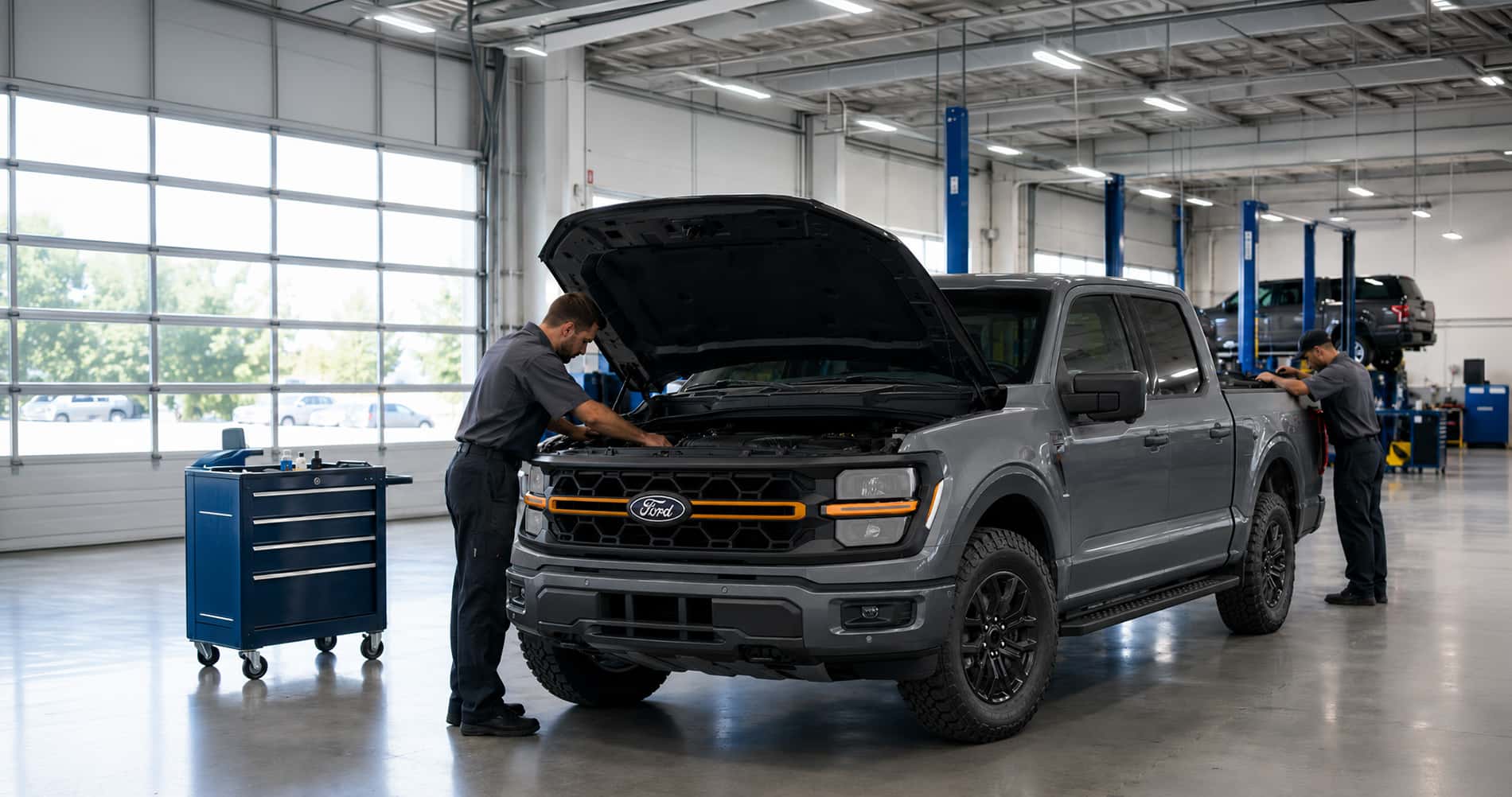
Know when to service your F-150, what changes when you tow or work your truck, and how engine choice affects oil, filters, spark plugs, fluids, and PowerBoost Hybrid maintenance.
The Ford F-150 maintenance schedule is not one-size-fits-all. A daily-driven F-150 near White Hall, an EcoBoost tow vehicle, a 5.0L V8 commuter, a 4WD work truck, and a PowerBoost Hybrid with Pro Power Onboard can all need different service conversations. Local driving around north-central West Virginia can add steep roads, winter conditions, gravel, towing, and job-site use to the maintenance plan.
At Toothman & Sowers Ford, we help F-150 owners around White Hall, Fairmont, Bridgeport, Morgantown, and nearby north-central West Virginia communities understand service timing without turning maintenance into guesswork. This guide explains the regular Ford F-150 maintenance schedule, the severe-use schedule, Ford’s Intelligent Oil-Life Monitor, towing-related maintenance, engine-specific service notes, and PowerBoost Hybrid items to ask about.
Use this page as a practical owner guide, not as a replacement for your owner’s manual. Your exact Ford F-150 maintenance schedule can vary by model year, engine, drivetrain, trim, towing use, off-road use, vehicle condition, software updates, equipment, and dashboard messages. Always follow your owner’s manual, oil-life monitor, and Toothman & Sowers Ford service advisor guidance for your specific truck.
Start with the regular schedule, then check whether your truck fits severe-use conditions. After that, confirm engine-specific items such as oil filter, oil capacity, spark plug timing, transfer case fluid, and PowerBoost Hybrid checks.
Use this table as the regular maintenance starting point for common Ford F-150 service items. Your oil-life monitor, owner’s manual, engine, drivetrain, and service history should confirm the final timing.
Swipe sideways on mobile to view the full Ford F-150 maintenance schedule.
| Regular Ford F-150 Maintenance Schedule | ||
|---|---|---|
| Interval | Service | Notes |
| Ford Intelligent Oil-Life Monitor / 7,500–10,000 mi | Engine oil and oil filter | Oil filter varies by engine. |
| Every oil change / 7,500 mi | Tire rotation | Check pressure and tread wear. |
| Every 6 months | Visual brake inspection | Inspect pads, rotors, and brake condition. |
| 20,000–25,000 mi | Cabin air filter | Inspect sooner for dust or pollen. |
| 30,000 mi | Engine air filter | Inspect sooner in dusty conditions. |
| 30,000 mi | Brake fluid inspection | Replace if contaminated. |
| 30,000 mi | Front / rear axle fluid inspection | Check leaks and fluid condition. |
| 60,000 mi | EcoBoost spark plugs | Confirm model year and plug spec. |
| 60,000 mi | Transfer case fluid | 4WD models only; applies where equipped. |
| 90,000–100,000 mi | 5.0L V8 spark plugs | Confirm engine before service. |
| Every 2–3 years | Brake fluid replacement | Use shorter timing for towing. |
| Every 3 years | Engine coolant replacement | Check sooner under heavy use. |
The regular schedule works best for F-150 trucks that mostly see commuting, errands, light hauling, and occasional weekend use. If your truck tows, idles, works on job sites, drives on gravel, or spends time in mud or snow, compare your routine with the severe-use schedule below.
Use severe-use timing when your F-150 regularly tows, hauls, idles for long periods, works on job sites, drives in dust, climbs steep grades, runs in extreme temperatures, or uses 4WD in mud or snow. Around north-central West Virginia, that can include winter commuting, gravel roads, trailer towing, steep routes, and weekend hauling.
Swipe sideways on mobile to view the full severe-use maintenance schedule.
| Severe-Use Ford F-150 Maintenance Schedule | ||
|---|---|---|
| Interval | Service | Notes |
| 5,000–7,500 mi | Engine oil and oil filter | Use when the truck tows, hauls, idles, works in heat, takes short trips, or sees job-site use. |
| 15,000 mi | Engine air filter inspection | Inspect early for dust, gravel, farm roads, construction sites, or off-road use. |
| 30,000 mi | Front / rear axle fluid inspection | Replace if discolored, contaminated, leaking, or overdue. |
| 45,000–60,000 mi | EcoBoost spark plugs | Confirm engine, model year, plug spec, towing use, and high-load driving history. |
| 60,000 mi | Automatic transmission fluid | Important for regular towing, heavy hauling, heat, and work-truck use. |
| 60,000 mi | Transfer case fluid | 4WD models only; important for towing, snow, mud, gravel, or off-road use. |
| Every 2 years | Brake fluid replacement | Use shorter timing for towing, steep roads, payload, and frequent braking. |
| Every 2 years | Coolant check / replacement review | Confirm timing by model year, engine, towing history, heat exposure, and workload. |
Severe-use maintenance matters because the truck works harder in these conditions. Around north-central West Virginia, that can mean steep roads, winter driving, gravel, trailer towing, side-by-side hauling, job-site use, and long idling just as much as commercial fleet work.
F-150 maintenance near White Hall is often shaped by how trucks are used across north-central West Virginia. Local roads, weather, terrain, and workload can make the severe-use schedule more relevant than many owners expect.
Campers, utility trailers, boats, equipment, and side-by-sides can move up oil, brake, transmission, axle, and coolant attention.
Regional hills can add load to brakes, cooling, transmission fluid, and drivetrain components, especially with a trailer or payload.
Snow, slush, salt, mud, and regular 4WD use make tire condition, brakes, axle fluid, and transfer case service more important.
Gravel roads, construction sites, farm roads, and long idle time can shorten filter checks and oil-service planning.
When you schedule F-150 service, tell the advisor whether your truck commutes, tows, hauls, idles, runs 4WD, or works off pavement. That local-use context helps match your truck to the right service plan.
If your F-150 tows, hauls, runs 4WD, idles on job sites, or sees steep roads and winter conditions around north-central West Virginia, Toothman & Sowers Ford can help review the right maintenance timing for your truck.
Engine choice changes oil filter, oil capacity, spark plug timing, and service questions. Confirm your engine before ordering parts or approving engine-specific service.
Swipe sideways on mobile to view the full F-150 engine maintenance chart.
| Ford F-150 Engine Maintenance Lookup | ||||
|---|---|---|---|---|
| Engine | Oil Filter | Oil Capacity | Oil Spec | Spark Plug Planning |
| 2.7L EcoBoost V6 | FL-2062A | 6.0 qt | 5W-30 | 60,000 mi |
| 3.5L EcoBoost V6 | FL-500S | 6.0 qt | 5W-30 | 60,000 mi |
| 5.0L V8 | FL-500S | 7.7 qt | 5W-30 | 90,000–100,000 mi |
| 3.5L PowerBoost Hybrid | FL-500S | 6.0 qt | 5W-30 | 60,000 mi |
| 3.3L V6 | FL-500S | 6.0 qt | 5W-30 | 90,000 mi |
The engine table helps you avoid the most common F-150 maintenance mistake: treating all engines the same. Confirm your engine before an oil change, spark plug service, or parts order.
The F-150 PowerBoost Hybrid shares core 3.5L EcoBoost service needs, but the hybrid system adds extra items to discuss during service.
Swipe sideways on mobile to view the full PowerBoost maintenance table.
| F-150 PowerBoost Hybrid Maintenance Items | |||
|---|---|---|---|
| Item | Timing | Why It Matters | Ask About |
| Oil and filter | 5,000–7,500 mi if towing / generator use | PowerBoost still uses a gasoline engine. | Oil-life percentage and use pattern. |
| Hybrid battery system | At service visits | Hybrid system status and fault-code awareness. | Any stored codes or updates. |
| 12V auxiliary battery | Annually | PowerBoost has added battery considerations. | Battery health and age. |
| Regenerative braking | Annually / during brake checks | Brake feel and wear pattern can differ. | Brake wear and system behavior. |
| Pro Power Onboard | Annually if used often | Frequent generator use adds service questions. | Output, inverter, and use history. |
| Hybrid cooling | At service visits | Hybrid components need proper thermal management. | Cooling airflow and coolant condition. |
The PowerBoost Hybrid does not skip truck maintenance. It adds another layer to it. Tell the advisor if you tow, idle, use Pro Power Onboard often, or notice changes in braking behavior.
Ford’s Intelligent Oil-Life Monitor helps estimate oil change timing based on how your F-150 is driven instead of relying only on a fixed mileage interval. It can help account for use patterns such as engine load, temperature, trip length, and operating conditions.
For normal driving, the oil-life monitor may allow a longer window. For towing, heavy loads, short trips, long idling, job-site use, off-road driving, or extreme temperatures, it is smart to discuss a shorter oil-service plan.
After each oil change, make sure the oil-life monitor is reset. If you are unsure, ask the Toothman & Sowers Ford service team to confirm the reset before you leave.
These sections explain the service questions F-150 owners most often run into after checking the regular and severe-use schedules.
Need to schedule maintenance now, compare F-150 capability, or keep researching before your next truck? Use these Toothman & Sowers Ford links to plan service, review F-150 ownership details, or continue shopping.
DISCLAIMERS:
*Maintenance information on this page is general guidance for Ford F-150 owners and may vary by model year, engine, trim, drivetrain, transmission, towing use, vehicle condition, driving conditions, software updates, equipment, and market. Always follow your owner’s manual, Intelligent Oil-Life Monitor, dashboard messages, and Toothman & Sowers Ford service advisor guidance for your specific truck.
*Maintenance intervals, oil-life percentages, service messages, parts references, and service needs may vary based on actual vehicle use and configuration.
*Towing, hauling, idling, off-road driving, job-site use, steep grades, extreme temperatures, short trips, snow, mud, and dusty roads can change service timing. Confirm the correct severe-use schedule for your F-150 before service.
*PowerBoost Hybrid maintenance may differ from gas-only F-150 maintenance. PowerBoost owners should confirm service requirements with the owner’s manual and a Ford service advisor.
*Some items, including transfer case fluid, axle fluid, spark plugs, PowerBoost Hybrid checks, and parts references, apply only to specific configurations or model years. Confirm applicability before service.
*Service specials, pricing, availability, appointment times, and coupon terms may change without notice. Confirm current offers and details with Toothman & Sowers Ford before service.
*This page does not diagnose vehicle concerns, replace professional inspection, or guarantee vehicle performance, reliability, warranty coverage, or repair outcomes.